20 Essential Violin Accessories Every Player Should Own

A violin alone is not enough. The right accessories protect the instrument, make practice easier, and help players sound better faster.
This list is ordered from daily essentials to useful add-ons for lessons, rehearsals, performances, and travel. It covers beginners through advanced players, plus anyone choosing gifts or starter violin equipment.

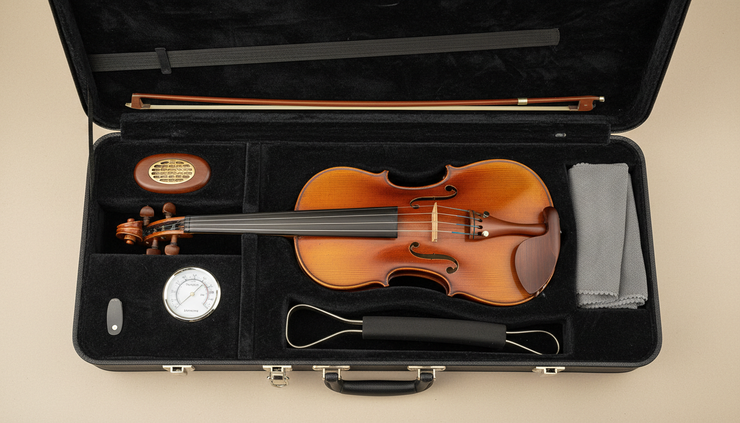
1. A protective violin case
A case protects the violin from knocks, dust, heat, and humidity swings. It is one of the few accessories every player needs from day one.
Beginners need a safe case for lessons and home storage. Intermediate and advanced players need stronger protection for rehearsals, concerts, and travel.
Look for:
A firm shell with good padding
Secure bow holders
A suspension system that keeps the violin raised from the case bottom
Weather-resistant outer fabric
Comfortable backpack straps
A hygrometer if climate control matters
For air travel, check airline size rules before buying. A hard, shaped case is compact. An oblong case gives more room for music, shoulder rests, and spare accessories.
2. A comfortable shoulder rest
A shoulder rest helps hold the violin without clamping the neck. It can improve comfort, posture, and stability.
Most beginners benefit from one because it reduces the urge to squeeze the violin between jaw and shoulder. Advanced players may still use one, but some prefer pads or no rest.
Choose based on:
Violin size
Shoulder shape
Neck length
Adjustability
Grip on the violin edges
The rest should not force the violin too high. It should support a relaxed left hand and allow the instrument to sit securely.
3. A chin rest that fits
The chin rest affects how the violin sits against the jaw. A poor fit can cause tension, slipping, and poor posture.
Many violins come with a standard chin rest, often side-mounted. That works for many players, but not all. Players with longer necks, narrower jaws, or sensitive skin may need a different shape.
Key points:
The jaw should rest naturally, not press hard
The edge should not dig into the neck
The violin should stay stable with light support
The metal fittings should not irritate the skin
A teacher or luthier can help test different models. This is more reliable than guessing from photos.
4. Rosin for the bow
Rosin adds grip between bow hair and strings. Without it, the bow slides and produces a weak, glassy sound.
Every violinist needs rosin. New bows need more at first, while daily players need light, regular use.
Consider:
Light rosin for a cleaner feel and warmer climates
Dark rosin for stronger grip, often in cooler or drier rooms
Low-dust options for players sensitive to powder
A case or cloth wrap to prevent cracking
Do not over-rosin. Too much builds up on strings and the violin top, which can dull the sound.
5. A clip-on tuner
A tuner helps players check pitch quickly. Clip-on models sense vibration, so they work well even in noisy rooms.
Beginners need a tuner to learn accurate pitch. Intermediate players use it to check open strings. Advanced players often tune by ear, but a tuner still helps in loud rehearsal spaces.
Choose one with:
A clear display
Fast response
A secure clip
Chromatic tuning mode
Calibration for A, often set around 440 Hz depending on the group
A tuner is a tool, not a replacement for listening. Use it to set the strings, then train the ear with scales and drones.

6. A stable music stand
A music stand keeps sheet music at the right height. Bad posture often starts with music placed too low or too far away.
A folding stand suits home practice and travel. A solid stand is better for studios, serious practice rooms, and ensemble work.
Look for:
Adjustable height
A stable base
A wide tray for music books
Page holders for outdoor or fan-cooled rooms
A carry bag if it travels often
Parents buying for children should avoid flimsy stands that collapse under method books. A stand should hold music without shaking.
7. A soft cleaning cloth
A clean microfibre cloth removes rosin dust, sweat, and fingerprints after playing. This protects the varnish and keeps the strings responsive.
Every violin case should have one. Use it after each practice session.
Best practice:
Wipe strings gently
Wipe the fingerboard
Clean the chin rest area
Avoid using household cleaners
Keep the cloth dry
Rosin dust can harden over time. Once it sticks to varnish, cleaning becomes a job for a luthier.
8. A string cleaner or careful cleaning kit
A basic cleaning kit can help maintain strings and fittings, but it must be used carefully. Many violin finishes are sensitive to alcohol and solvents.
For most players, a dry cloth is enough. Use string cleaner only if the label clearly states it is suitable for bowed strings, and keep it away from varnish.
Choose:
Violin-safe products only
Small applicators
Clear instructions
No harsh household chemicals
If rosin has built up on the violin body, do not scrape it. Take the instrument to a qualified repairer.
9. Spare violin strings
Strings break. They also lose tone with use. A spare set prevents panic before lessons, exams, and performances.
Beginners should keep at least one spare E string. Intermediate and advanced players should carry a full set.
Common string types include:
Steel core, stable and direct
Synthetic core, warmer and flexible
Gut core, complex sound but more sensitive to weather
Match the string size to the violin. Most full-size violins use 4/4 strings. Smaller instruments need the correct fractional size.
10. A spare E string
The E string deserves its own mention because it breaks more often than the lower strings. It is thin, high-tension, and changed more frequently.
Every case should have one, even if a full spare set feels costly.
Look for:
Ball end or loop end, depending on the fine tuner
The correct scale length
A tone that matches the rest of the set
A plated option if plain steel sounds too sharp
Sealed packaging helps prevent corrosion, especially in humid climates.
11. Fine tuners
Fine tuners make small pitch adjustments easier. Most beginner violins have four. Many advanced setups use one fine tuner on the E string, especially with synthetic or gut-core strings.
Who needs them:
Beginners who struggle with pegs
Children using fractional violins
Players with steel strings
Anyone needing fast tuning in rehearsals
Built-in fine tuner tailpieces are neat and light. Add-on fine tuners are common but can affect string length if fitted poorly.
If pegs work badly, do not rely only on fine tuners. The pegs may need attention.

12. A practice mute
A practice mute reduces volume by limiting bridge vibration. It is useful for flats, hotels, late-night practice, and shared homes.
It does not make a violin silent. It lowers the sound and changes the tone.
Choose:
Rubber for moderate reduction
Metal for stronger reduction
A secure fit over the bridge
A shape that will not damage strings or varnish
Use it for technical practice, scales, and note learning. Do not use it all the time, because players still need to hear full tone and bow response.
13. An orchestral mute
An orchestral mute is different from a heavy practice mute. It creates a softer, veiled sound for music marked `con sordino`.
Students encounter it in ensemble music. Advanced players need one for orchestra, chamber music, and auditions.
Good options:
Slide-on styles that stay on the strings
Small rubber mutes for quick use
Models that do not rattle
Keep it on the strings between the bridge and tailpiece when not in use. That makes fast changes easier.
14. A metronome
A metronome builds steady rhythm. It is one of the violin essentials for scales, études, shifting, and difficult passages.
Players at all levels need one. Beginners use it to count evenly. Advanced players use it to test control at slow and fast tempos.
Consider:
Digital metronome
App-based metronome
Mechanical metronome
Combined tuner and metronome
Start slower than performance speed. Clean rhythm at a slow tempo beats rushed, uneven playing.
15. A pencil and eraser
A pencil belongs in every case. It marks bowings, fingerings, cuts, repeats, and teacher notes.
Use pencil, not pen. Music changes often during lessons and rehearsals.
Good case items:
A soft pencil
A clean eraser
A small sharpener
Sticky page markers if allowed by the teacher
This tiny accessory prevents missed instructions and rehearsal delays.
16. A notebook or practice journal
A practice journal records assignments, tempos, problem bars, and goals. It helps players avoid repeating the same unfocused practice every day.
Beginners can track teacher instructions. Intermediate players can note shifting, vibrato, and intonation work. Advanced players can plan repertoire, excerpts, and audition preparation.
Useful entries include:
Date
Pieces practised
Target bars
Metronome marks
What improved
What needs work next
A simple notebook is enough. The value comes from using it often.
17. A humidifier or humidity control pack
Wood reacts to moisture. Dry air can contribute to open seams, cracks, and slipping pegs. Very humid air can make pegs swell and affect instrument response.
Players in air-conditioned rooms, dry winters, or humid tropical climates should watch case humidity.
Options include:
Case humidifiers
Two-way humidity control packs
Case hygrometers
Room humidity monitors
Do not over-wet any humidifier. Water and violins are a bad mix. Follow the product instructions and ask a luthier if the instrument is valuable.
18. A bow case or bow tube
A bow is fragile. The stick can warp, the tip can break, and bow hair can stretch or snap. A case or tube protects spare bows during travel.
Who needs it:
Players carrying more than one bow
Students travelling between school and lessons
Advanced players with carbon fibre and wood bows
Anyone shipping or storing a bow separately
Look for a rigid tube, secure end caps, and enough internal padding. Always loosen the bow hair before storing it.
19. A page holder or music clips
Music clips keep pages open and still. They are useful outdoors, near fans, in air-conditioned halls, and with thick music books that refuse to stay flat.
Simple options work best:
Stand clips
Elastic page holders
Magnetic clips for compatible stands
Transparent page weights for home practice
Do not use clips that cover important notes or markings. For performances, test page turns before walking on stage.
20. A reliable case strap or backpack system
A weak strap can drop the case. That can damage the violin even if the case is good.
Players who commute, walk to lessons, or take public transport need reliable straps. Parents buying for children should check the strap length and weight balance.
Look for:
Strong stitching
Metal or heavy-duty clips
Padded shoulder sections
A chest strap for small players
Secure attachment points on the case
If a strap starts fraying, replace it. Do not wait for it to fail.
What to buy first
For a new player, start with the basics:
Protective case
Shoulder rest
Rosin
Clip-on tuner
Music stand
Cleaning cloth
Spare E string
Pencil
That starter set covers protection, tuning, posture, practice, and daily care. After that, add mutes, spare strings, humidity control, and better storage as the player’s needs grow.
For advanced players, the best violin accessories are not the fanciest ones. They are the items that solve real problems: stable tuning, safe travel, clean sound, reliable practice, and instrument care.
Good accessories do not replace good technique. They remove friction from practice and protect the instrument that makes the work possible. If choosing a gift, pick something useful, durable, and easy to use. A high-quality cloth, spare strings, a good stand, or a secure case strap will get used far more than a novelty item.


Comments