What Size Violin Do I Need? Complete Violin Size Guide

A violin that’s too big can make a beginner feel clumsy before they’ve even played a note. A violin that’s too small can cramp the hand and hold back tone. Size matters, but it’s not about age alone.
The right violin size should let the player hold the instrument comfortably, reach the notes without strain, and build good technique from the start. This guide covers 1/16, 1/10, 1/8, 1/4, 1/2, 3/4, and full-size 4/4 violins, with practical checks for children and adults.
If you’re wondering, what size violin do I need, start with arm length, comfort, and teacher fit checks. Age can give a rough clue, but it should never make the final decision.

Why age alone is a poor way to choose a violin
Age charts are common, but they’re only a starting point. Two children of the same age can have very different arm lengths, shoulder width, hand size, and posture. One 7-year-old may fit a 1/4 violin well. Another may need a 1/2, or may still be more comfortable on a 1/8.
Adults have the same issue. Most adult beginners use a 4/4 violin, but not every adult is most comfortable on one. A smaller adult, or someone with shorter arms or limited shoulder comfort, may play better on a slightly smaller instrument. A 3/4 violin can be more manageable for some adults, though tone and projection may differ from a full-size instrument.
Good sizing looks at:
Arm length
Hand shape and finger reach
Shoulder comfort
Neck and jaw position
Ability to hold the violin without gripping
Comfort while playing, not just while standing still
A violin can look right in a case and still feel wrong under the chin. Fit has to be checked in playing position.
The main violin sizes from 1/16 to 4/4
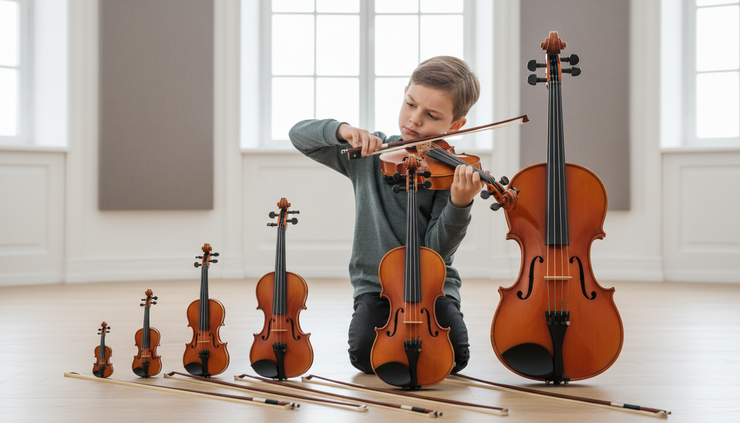
Violins come in fractional sizes. A 1/2 violin isn’t literally half the size of a full-size violin. The fractions are naming conventions used to group instruments by size.
Use the table below as a practical starting point. Measurements vary slightly by maker, and a teacher should confirm the final fit whenever possible.
Violin size | Common starting point | Approximate arm length from neck to palm | Typical player notes |
1/16 | Very young children | Around 35 cm | For very small players starting early |
1/10 | Young children between 1/16 and 1/8 | Around 38 cm | Useful when 1/8 feels too large |
1/8 | Young children | Around 42 cm | Common early beginner size |
1/4 | Growing children | Around 47 cm | Often used after 1/8 when reach improves |
1/2 | Older children | Around 52 cm | A common middle size before 3/4 |
3/4 | Older children, teens, some adults | Around 56 cm | Often the last size before full-size |
4/4 full size | Teens and adults | Around 58.5 cm or more | Standard adult violin size |
These are not strict rules. They’re checkpoints. The player’s comfort matters more than matching a chart.
This is where a good violin size guide helps, especially when comparing violin sizes for children, deciding between a 3/4 vs 4/4 violin, choosing a full size violin, or learning how to measure violin size before trying instruments in person.
How to measure for violin size at home
You don’t need special equipment. A measuring tape is enough for a first check.
Here’s the simple method:
Ask the player to stand or sit upright.
Have them extend the left arm straight out to the side.
Keep the palm facing up.
Measure from the base of the neck to the middle of the palm.
Compare that measurement with a sizing chart.
Try the violin in playing position before making the final choice.
Measure to the palm, not just to the wrist. The hand needs to curve around the neck of the violin and reach the fingerboard comfortably.
Some shops or teachers also measure from the neck to the wrist. That gives a more conservative size estimate. If the palm measurement suggests one size and the wrist measurement suggests a smaller size, try both. Many teachers would rather start a beginner on a slightly smaller violin than one that’s too large.
A violin that “fits” on paper still has to pass the comfort test under the chin.
The player should not need to lift the shoulder, lock the elbow, twist the wrist, or stretch hard to reach first position. Those habits can form quickly, especially in beginners.

How teachers check whether a violin fits
A teacher will usually look beyond the measurement. They’ll watch how the player holds the violin and whether the left hand can move naturally.
One common check is the scroll test:
The player holds the violin in playing position.
The left arm reaches around the violin.
The hand should be able to cup or reach the scroll comfortably.
The elbow should not lock.
The shoulder should stay relaxed.
If the player has to stretch hard to reach the scroll, the violin may be too large. If the arm bends sharply and the instrument looks cramped, it may be too small.
Teachers also check the left hand. The fingers should be able to curve over the fingerboard without collapsing. The thumb should sit naturally, not squeeze tightly. The wrist should not bend sharply inward or outward.
Bow arm comfort matters too. The right arm needs room to move across the strings without the body twisting or the shoulder rising. A violin that’s too large can make bow control harder because the player is already fighting the hold before the bow touches the string.
For children, teachers often watch for signs of fatigue. A child may say the violin is fine at first, then start dropping the scroll, gripping with the chin, or losing posture after a few minutes. That can mean the size is too demanding.
For adults, teachers may ask about shoulder, neck, and left-hand comfort. Adults often try to “push through” discomfort, but tension can slow progress. A slightly smaller instrument may help some adult beginners learn with better balance.
Signs the violin is too large
An oversized violin can make basic skills harder than they need to be. Beginners may think they’re struggling because they lack talent, when the instrument is working against them.
A violin may be too large if the player:
Can’t comfortably reach the scroll during the fit check
Locks the left elbow when holding the instrument
Raises the left shoulder to support the violin
Grips tightly with the jaw or left hand
Struggles to curve the fingers over the fingerboard
Has a collapsed wrist or strained thumb
Gets tired quickly while holding the violin
Has trouble keeping the violin level
Finds simple finger patterns unusually stretched
The biggest issue is tension. Violin playing needs small, flexible movements. If the instrument is too big, the player often compensates by squeezing. That affects intonation, shifting, vibrato later on, and bow control.
For children, an oversized violin can also make practice frustrating. A child may avoid playing because holding the violin feels awkward or tiring. Starting with the right size gives them a better chance to enjoy the early stages.
For adults, using a violin that’s too large can create neck, shoulder, or hand discomfort. Pain isn’t part of learning violin. Some muscle tiredness is normal at the start, but sharp strain or repeated discomfort is a warning sign.
Signs the violin is too small
A smaller violin is often safer than one that’s too big, especially for young beginners. Still, a violin can become too small as the player grows.
A violin may be too small if the player:
Feels cramped in the left hand
Has to bend the left arm too much
Finds the fingers crowded together
Pulls the bow too close to the body
Produces a thin sound despite good bow use
Looks folded around the instrument
Has outgrown the scroll test by a wide margin
Children can outgrow fractional violins quickly. Check fit every few months during growth spurts. If the player’s hand and arm look cramped, or the teacher says finger spacing has become too tight, it may be time to move up.
That said, don’t rush to a larger violin just because a child is growing. The new size should still feel comfortable. Moving up too early can undo good posture and make playing feel harder.
Choosing between 3/4 and 4/4 violins
The jump from 3/4 to 4/4 is a common question for older children, teens, and smaller adults.
A 4/4 violin is the standard adult size. It usually offers a fuller sound and more instrument choice. Many teens move to 4/4 once their arm length and hand reach are ready.
A 3/4 violin may still be the better choice when:
The player strains to reach the scroll on a 4/4
The left shoulder rises on a full-size violin
Finger reach feels stretched
The player has a smaller frame
Comfort drops after a short practice session
For adults, there’s no rule that says 4/4 is always best. Many adults do well on full-size violins, but comfort should lead the decision. If a 4/4 causes tension and a 3/4 allows relaxed playing, the smaller size deserves serious consideration. A teacher can also discuss whether a 7/8 violin is suitable, if available, though 4/4 and 3/4 are far more common.
Why an oversized violin makes technique harder
Technique develops around the body. If the violin is too large, the body starts building habits around strain.
An oversized instrument can make these basics harder:
Left-hand shape
The fingers may flatten because they’re reaching too far. This makes clean notes harder.
Thumb position
The thumb may squeeze the neck to support the instrument. That limits movement.
Wrist alignment
The wrist may bend awkwardly. This can affect intonation and comfort.
Bow control
If the violin feels heavy or unstable, the right arm may tense up too.
Posture
The player may lift the shoulder, tilt the head too much, or twist the body.
These problems don’t always look dramatic. Sometimes they show up as small struggles: scratchy bowing, tight fingers, poor tuning, or quick fatigue. The player may practise more, but the root problem is fit.
A well-sized violin won’t make playing easy overnight. Violin still takes patience. But it removes one unnecessary obstacle.

Practical advice for children and adults
For children, choose the violin that supports relaxed posture now. Don’t buy a size up just to make it last longer. A violin that’s too large can slow learning and create tension. Renting or exchanging sizes as the child grows is often more practical than forcing a big instrument too early.
Recheck size if:
The child has had a growth spurt
The teacher notices crowding or stretching
The child complains of discomfort
The violin no longer sits naturally
Finger spacing feels too tight or too wide
For adult beginners, start by trying a 4/4 violin, then compare it with a smaller size if needed. Pay attention to how the instrument feels after five to ten minutes, not just the first thirty seconds. Comfort during actual playing matters most.
Adults should also check chin rest and shoulder rest setup. Sometimes the violin size is fine, but the support setup is wrong. A teacher can help adjust this.
FAQ
Is a 4/4 violin only for adults?
No. A 4/4 violin is the standard full-size violin, but some teens are ready for it too. The right choice depends on arm length, hand reach, and comfort.
Can an adult play a 3/4 violin?
Yes. Some adults are more comfortable on a 3/4 violin, especially if a 4/4 feels strained. The sound may be smaller, but comfort and healthy technique matter.
Should I buy a larger violin so my child can grow into it?
Usually, no. A violin that’s too large can cause tension and make basic technique harder. It’s better to choose the size that fits now.
How often should a child’s violin size be checked?
Check every few months, especially during growth spurts. Also check if posture changes, finger spacing looks cramped, or the teacher recommends moving up.
Is a smaller violin easier to play?
Only if it fits. A smaller violin can help with reach and comfort, but one that’s too small can feel cramped. The best size is the one that allows relaxed, balanced playing.
The best violin size is the one that lets the player move freely
A sizing chart is helpful, but it’s only the first step. The real test is how the violin feels in playing position.
Choose a size that lets the shoulder stay relaxed, the left hand curve naturally, and the bow arm move freely. For children, check fit often as they grow. For adults, don’t assume full-size is the only valid choice if comfort says otherwise.
The right violin won’t do the practising for anyone. But it will make the first steps cleaner, calmer, and far less frustrating.


Comments